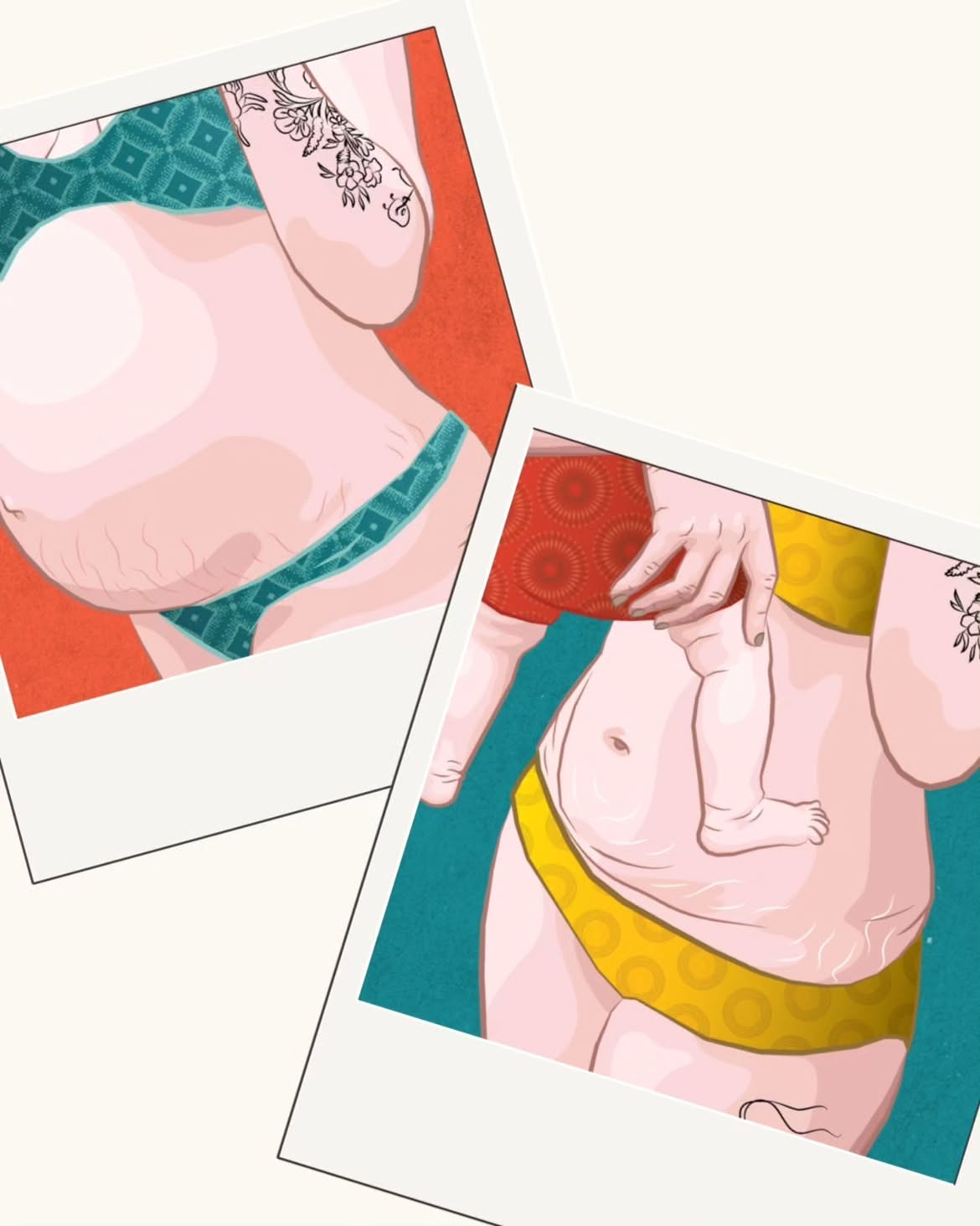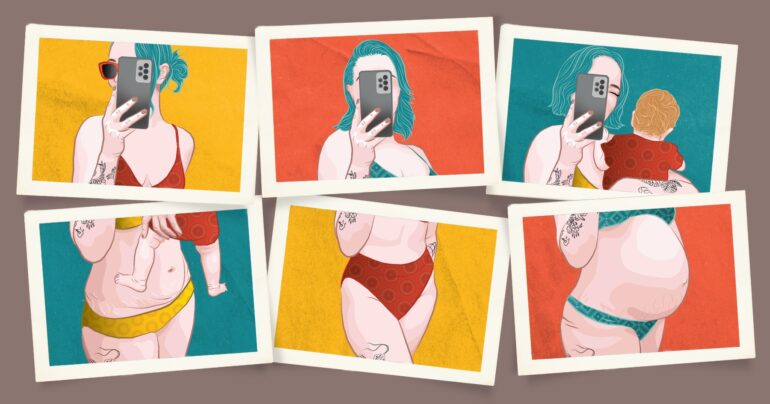

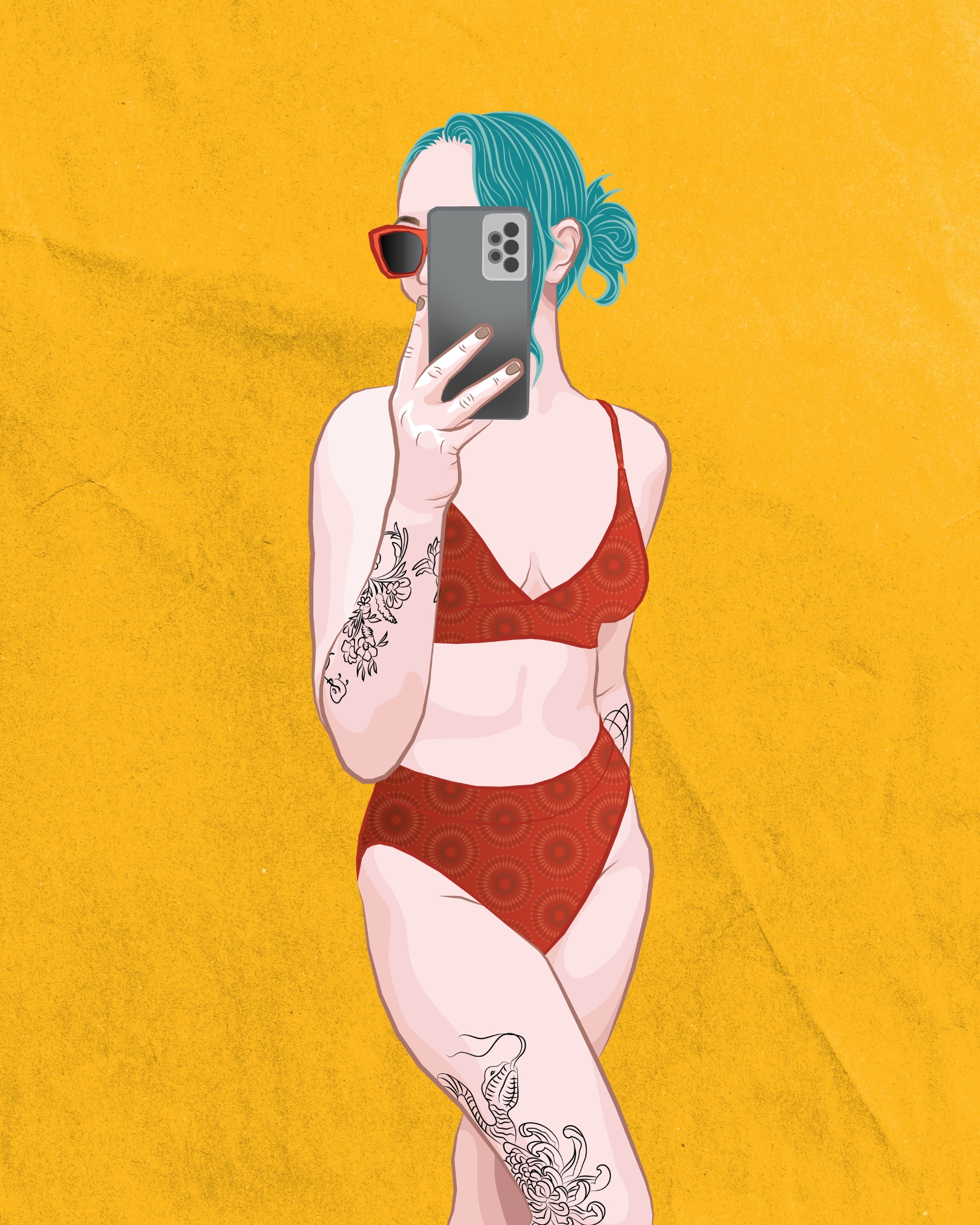
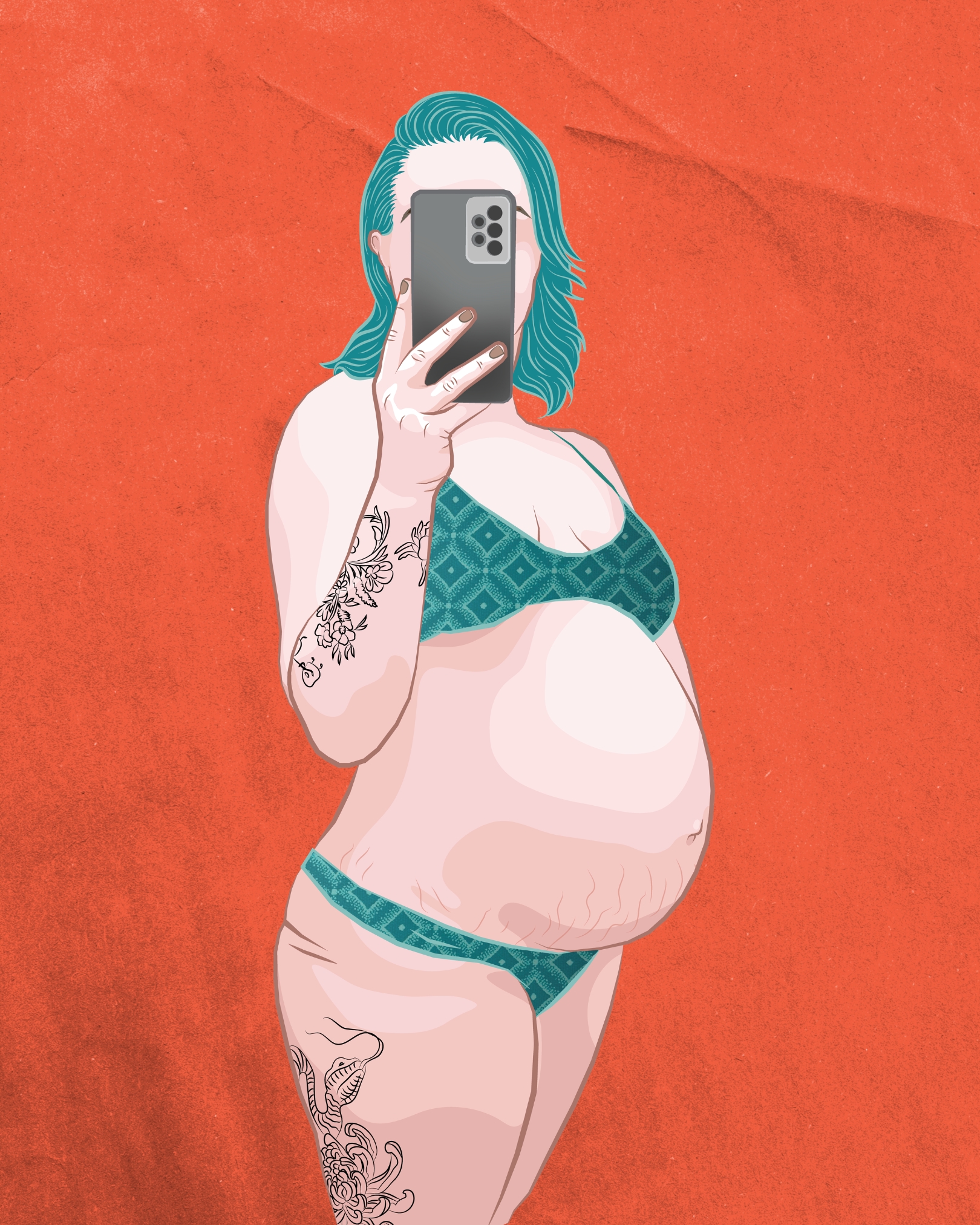
We came across Maya Molony’s work through her series of illustrations exploring the female body, and this particular piece immediately caught our attention.
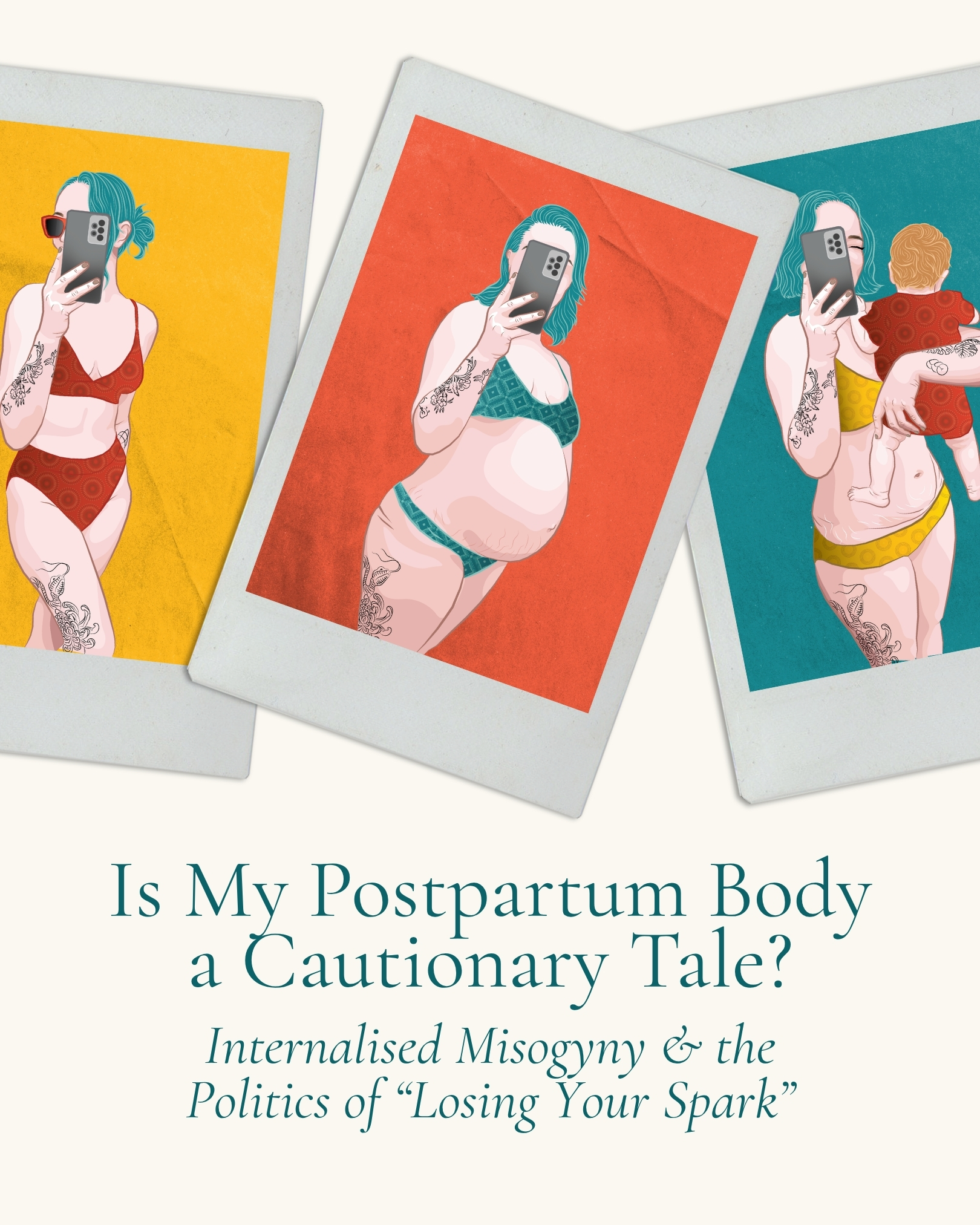
Through bold, colourful illustrations and a deeply personal essay, Maya looks at the way women are taught to see their changing bodies as something to fear, fix or hide, particularly after pregnancy.
It’s honest, feminist and, at times, uncomfortably relatable. And that’s exactly why we wanted to share it.
Is My Postpartum Body a Cautionary Tale? explores internalised misogyny, body image and the pressure placed on women to “bounce back”, while asking a much bigger question: why are we so afraid of being marked by the things that matter?
Read Maya’s full essay below. ♡
By Maya Molony
“I won’t lose my spark after pregnancy,” the text on screen says. My thumb freezes mid-scroll. I watch a young woman smile at me through her phone before the video cuts to a different clip of her, now postpartum. She looks heavier. Softer. Miserable. “Don’t tell no lie,” the music in the background scolds.
Drip.
“Oh, you’re breastfeeding?” the woman doing my nails asks brightly. “Don’t worry, babe, those extra kilos will melt right off!”
Drip.
“I watched motherhood take everything from my cousin,” reads the title of the Reddit post. “She’s told me through tears on the phone at 2 am that she gained over forty pounds. None of her clothes fit her. I visited her yesterday and cried in the car after.”
Drip.
I’m watching a TikTok of a woman working out. She gave birth to twins only a few months ago, she says. Her stomach has the texture of crepe paper. “Where’s the girl with the list?” says the top comment.
Drip.
I touch the numb edges of my C-section scar gingerly (drip) and run my hand up across my papery soft stomach (drip). I think of my favourite pair of pre-pregnancy jeans (drip), folded up and shamefully tucked away in the back of the cupboard (drip). I open my Instagram profile and scroll down to a year ago (drip), and I feel a lump form in my throat at the sight of my old body.
Drip (drip) drip.
The slow erosion of my self-esteem postpartum has been a torturous kind of self-hatred, made all the worse by the knowledge that I should know better. I’ve spent years arguing about body politics. I’ve read the books and nodded along to the lectures. I know that the shame I’m feeling is a result of a long history of disciplining women into smallness. Still, that knowledge hasn’t protected me. And the most unsettling part, I’ve discovered, is that the loudest enforcers of postpartum shame are not men. They are other women.
Shame has been my companion for as long as I can remember. I grew up a chubby kid. By the time I was a teenager, I’d become convinced that I was grotesquely fat. Looking back, I was a perfectly average sixteen-year-old, but it was the 2010s: the media was telling us that Bridget Jones was obese, and while I had friends who didn’t even weigh enough to donate blood, I was wearing size medium clothing (which might as well have been a plus size back then). In my early twenties, I was blindsided by a deep depressive episode, and I began to gain (and gain, and gain). My clothing sizes crawled up from medium to large to extra large to extra extra large. The 2020 lockdown didn’t help. I turned to food for solace, and I watched the number on the scale slide up (and up). The highest I ever saw it go was eighty, but I know it crept higher. I stopped weighing myself. It felt easier not to know.
I hated myself. I was trying desperately not to, but I couldn’t silence the bitter voice in my head that told me every day how disgusting I was. No matter how well-versed I thought I was in feminist theory, no matter how vocal I was about dismantling beauty standards, no matter how many photos I posted on social media with body-positive captions, the voice followed me still. I tried to drown it out. “The world doesn’t stop being beautiful while you’re hating on your body,” I would tell Instagram. “Don’t let your self-hatred prevent you from savoring the abundant beauty this world has to offer.” In spite of the rousing sentiments, I still dreamed of the ‘One Day’s. One day, I would lose the extra kilos and return to my teenage size. One day, I would fit into a medium again (or, dare I dream, a small?) One day, I would love my body.
Then, in my mid-twenties, I moved from Durban to Johannesburg and immediately, inexplicably, the weight began to fall off. I wasn’t trying (which, in a healthy society, should be a sign that something was wrong. Instead, it was taken as a sign that I was doing well). I was under a lot of stress. I had stomach issues. I threw up often. I blamed my antidepressants. I switched them. The nausea eased, but the weight continued to drop. I finally got a taste of what I had been dreaming of for so long. ‘One Day’ had arrived. I had lost the extra kilos. I was back to my teenage size. I could fit into a medium (and a small, and sometimes, depending on the item of clothing, an extra small). But did I love my body? Well… that was more complicated.
I’m ashamed to admit that inhabiting a smaller body felt (even now I hesitate to say it) good. I liked inhabiting less space. I liked how easy it was to find clothes that fit my body. I liked the way I looked in photos. Admitting that feels like betraying not only my former self, but also everyone to whom I had preached body positivity. I know why it felt good – I had fallen for the trick. But I couldn’t let on that I was so easy to manipulate. So instead of celebrating, I complained. I complained about needing new clothes, about not knowing how to dress my new body, about people telling me how good I looked (which only made me wonder how bad they must have thought I looked before). This is the part that feminism does not always allow us to admit: You can critique toxic beauty standards and still feel rewarded by them. Power operates not only through oppression, but also through pleasure, after all.
Just before my thirtieth birthday, I found out that I was pregnant. I was hit hard with morning sickness, and I went from my teenage size to even smaller. Instead of being pleased, it scared me. I looked brittle and weak. Even the new clothes I had bought to accommodate my smaller frame hung off me limply. I cried myself to sleep every night from the misery. What an achievement! Finally, I couldn’t donate blood. Then, in the second trimester, the morning sickness eased and was replaced with an animal hunger. Before I was pregnant, I was lucky to eat two meals a day. In the first trimester, I was lucky if I could keep anything down without throwing up. In the second trimester, if two hours went by without filling my stomach, I would feel violently sick, so I ate and ate and ate. I started to gain weight and, for the first time in my life, the weight gain came without shame. It felt healthy and good. It was a relief.
I discovered what it felt like to be proud of my belly. My favourite piece of clothing during my pregnancy was a long black dress (tight-fitting, elasticised, size large, heaven forbid). It would hug my curves and flatter my new roundness. It was liberating to want to show off something I’d spent so many years covering up. Not every woman dreams of being pregnant (God knows I didn’t enjoy it), but I wish that every woman could know the peace that pregnancy brings to your body image. Pregnancy offered me a loophole for the shame. I didn’t feel a sense of moral failure at my weight gain; I felt excited that I bore physical proof I was carrying a life.
But the loophole was temporary, and it ended the moment the baby exited.
After birth, I entered a liminal category. The pre-pregnancy clothes I had bought during those years of unintentional weight loss no longer fit me. My favourite jeans, acquired during my extra-small years, did not button anymore. When I came home from the hospital, I stubbornly tried to pull them up over my thighs, even though I knew I was just hurting my own feelings by trying. I had to admit defeat, and I hid them in the back of my cupboard where they couldn’t remind me of how much I’d failed. On the other hand, my older, larger clothes looked awkward on me, reminiscent of another body I had also outgrown. I exist now in no (wo)man’s land. I am not pregnant. I am not “back.” I am not what I was. But I am not allowed to stay changed, either.
Every time I open TikTok, my FYP is littered with postpartum women mourning their old bodies. They document the loss of their spark (‘spark’, of course, being a synonym for ‘smallness’ here). The implication is that pregnancy has ruined them. Clearly, they feel shame already, but it’s the comments that really rub salt in the wounds.
“This is my biggest fear.” Drip.
“I could never ruin my body for a baby.” Drip.
“SO not worth it.” Drip.
“This is why I don’t want kids.” Drip.
“Yeah, no thanks.” Drip.
“You’re living my worst nightmare.” Drip.
“No one can convince me that motherhood is not a humiliation ritual.” Drip.
And the one I hate the most:
“Where’s the girl with the list?”
Oh, the girl with the list. If you’ve spent any time on TikTok, you’ve probably met her. She keeps an ever-growing inventory of pregnancy hazards, from bleeding gums and swollen ankles to acne and varicose veins. This catalogue of horrors was supposed to help women be more informed, as a counter to the romanticisation of what can, truthfully, be an extremely dangerous experience. Once released into the wild, however, the list took on a life of its own. Now it circulates as a warning. Women see a new mother working out and, at the shock of seeing unsightly stretch marks, invoke the list in an act of primal fear.
It’s unsettling, the way we recoil from anything we deem an aesthetic liability. We wholeheartedly and uncritically absorb the idea that physical change in the ‘wrong’ direction is failure. We stand in front of the bathroom mirror, running our hands over our stomachs, and we let the erosion of our self-esteem wash over us. Whose eyes are we really looking at ourselves through? Margaret Atwood warned us about this decades ago: “You are a woman with a man inside watching a woman. You are your own voyeur.”
It’s unsettling, the way we recoil from anything we deem an aesthetic liability. We wholeheartedly and uncritically absorb the idea that physical change in the ‘wrong’ direction is failure.
As the pre-eminent South African feminist scholar, Pumla Dineo Gqola, puts it, “patriarchy produces a condition of women’s unease in their bodies”. It teaches us to think of ourselves as excessive and in need of discipline. The genius of the system is that it keeps us busy correcting ourselves. We are deliberately kneecapping ourselves. Willfully shrinking ourselves. “We are using energy,” Gqola warns us, “to make ourselves smaller so that we have nothing left to fight patriarchy.” If the goal is to keep women preoccupied with the management of their bodies, then the strategy has worked. A power structure has truly and thoroughly done its job when it has successfully taught its victims to police themselves with the tools of their oppressors. The patriarchy can dust its hands off and lean back in its leather armchair. Its job here is done, taken over by the girl with the fucking list.
It bears reminding that we are not born with an intrinsic fear of weight gain. We do not come into this world with a built-in instinct to scrutinise our bodies and weigh up their worth. We’re taught to do this by magazines and movies and men in boardrooms… and by other women. We learn to not only police ourselves, but also each other. We’ve constructed our own prison, our own panopticon, and we ‘behave’ ourselves because we keep reinforcing the belief in each other that we are being watched. The girl with the list is a warning we call upon to ward off the threat of noncompliance. Let’s name that for what it is: Internalised misogyny.
When I was in Grade 9, my English teacher ran the Comrades Marathon and hobbled into class the next day with a wicked sunburn, painful chafing, and ravaged muscles. She was burnt to a crisp. Stiff. Clearly exhausted. And yet, I have never heard anyone say they would never run a marathon for fear that it would ruin their body. Chefs are marked by burn scars on their forearms and knife cuts on their fingers. Construction workers are marked by calloused hands. Dancers lose toenails and wrap their blistered feet in tape. We accept that labour leaves marks everywhere else, except when that labour is reproductive. Then, we are expected to return to our previous form as quickly and discreetly as possible. To get our ‘spark’ back before we become an object of pity to other women.
I feel the need to clarify, as a woman who is still in the throes of postpartum, that ‘losing your spark’ is a very real phenomenon. The aftermath of birth can be physically and emotionally brutal: Your hormones are crashing. Your body is healing. You’re getting very little, if any, sleep. It’s inevitable that your sense of self wavers under that immense pressure, and I don’t want to minimise that. But that’s not really what women are talking about when we invoke the loss of a ‘spark’. The visual shorthand, over and over again, is weight gain. Stretch marks. Scars. The general appearance of being undone. We collapse a complex, destabilising life transition into a purely aesthetic failure.
I believe the reason for this is simple: the postpartum body disrupts the fantasy that women exist primarily for looking at. To frame it as ‘damaged’ is to insist that aesthetics are more important than actions or emotions. Women’s bodies have always been sites of regulation: they have historically been corseted, starved, dyed, plucked, and powdered. The pressure to ‘bounce back’ after having a baby is just the current iteration of a centuries-old order: contain the female body. Make it pleasing. Manage its excess.
But bodies are not meant to be static (for the purpose of aesthetics, or otherwise). They are meant to grow and change. They are meant to be lived in. They are meant to accumulate evidence. When we treat the body as something that must remain pristine and beautiful, we shrink the scope of the lives we feel permitted to live.
When we treat the body as something that must remain pristine and beautiful, we shrink the scope of the lives we feel permitted to live.
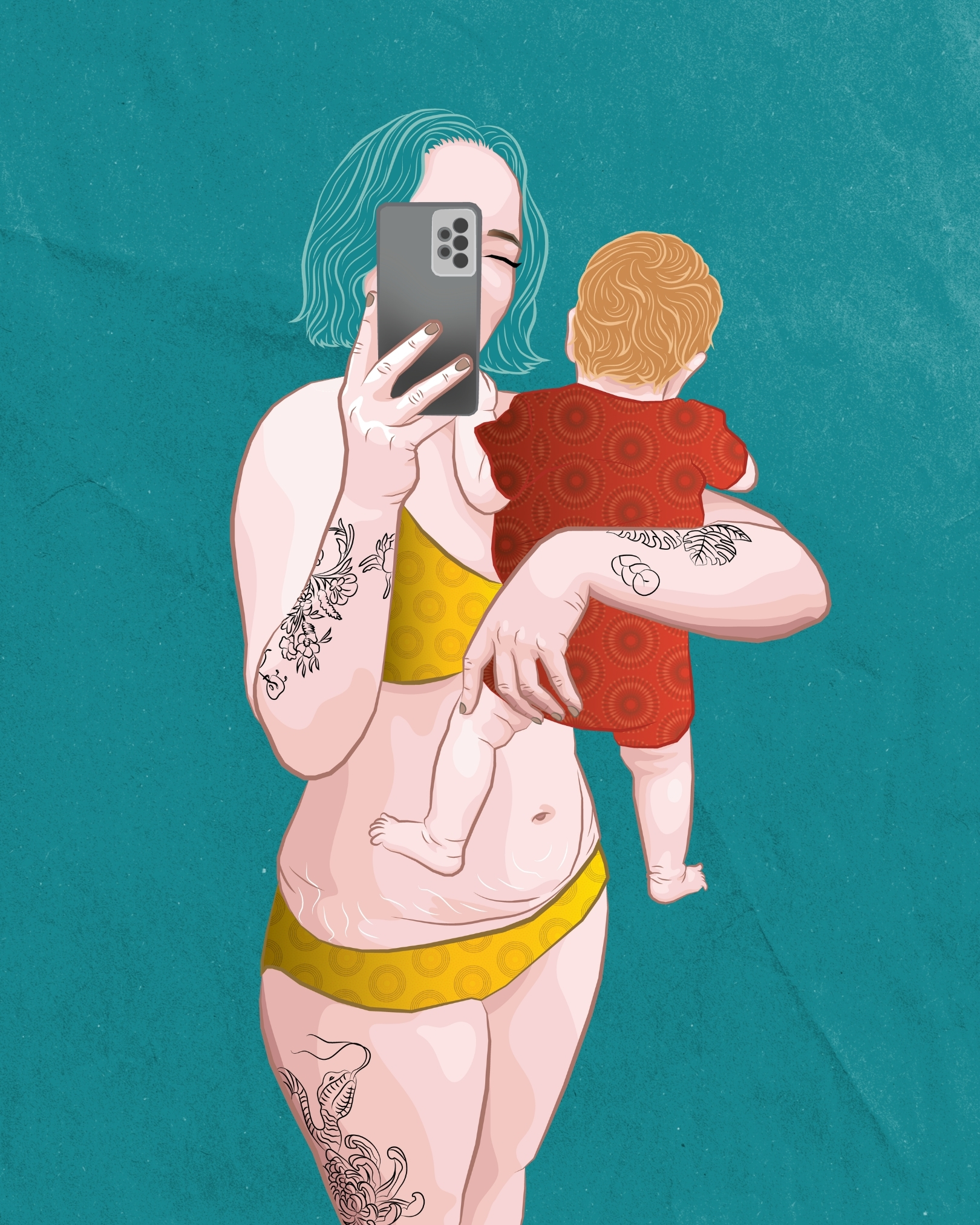
My body is softer now. It does not look like it did before. It bears evidence of the life I’ve lived and the things I’ve done. It has grown thinner and larger and thinner again. It has starved and stretched and drooped. In this current season of my life, it serves a new purpose. My stomach is not damaged because it has stretch marks. It stretched to accommodate my son as he grew. When I stop breastfeeding, my breasts will not be ruined because they are droopier. They grew to feed my son in the tender first months of his life, and then they will shrink again. My skin is not marred by my C-section scar. It bears evidence of the bravest thing I have ever done: painfully and viscerally brought life into this world. Don’t get me wrong, I am not trying to romanticise the sacrifice that pregnancy demands of you. I’m asking a question that goes beyond motherhood: Why are we so afraid of being marked by things that matter?
My body has done something historically ordinary and personally tremendous. It tells a story now that it did not tell before, and, moreover, I am still here inside it. So no, my body will not ‘bounce back.’ I hope it never does. I hope it continues to move forward, gathering proof of a life I am brave enough to live.
Pregnancy taught me an important lesson that I desperately needed to learn: I do not want to inhabit an extra small body. I do not want to inhabit an extra small life.
I want to live a life big enough to leave marks. Girl with the list be damned.